Power and light
Channel letter power supplies: 12 V sizing and placement
How sign power supplies work: 12 V DC, sizing watts with 20% headroom, Class 2 limits, plug-in or hard-wired, and where to put the power supply.
Updated
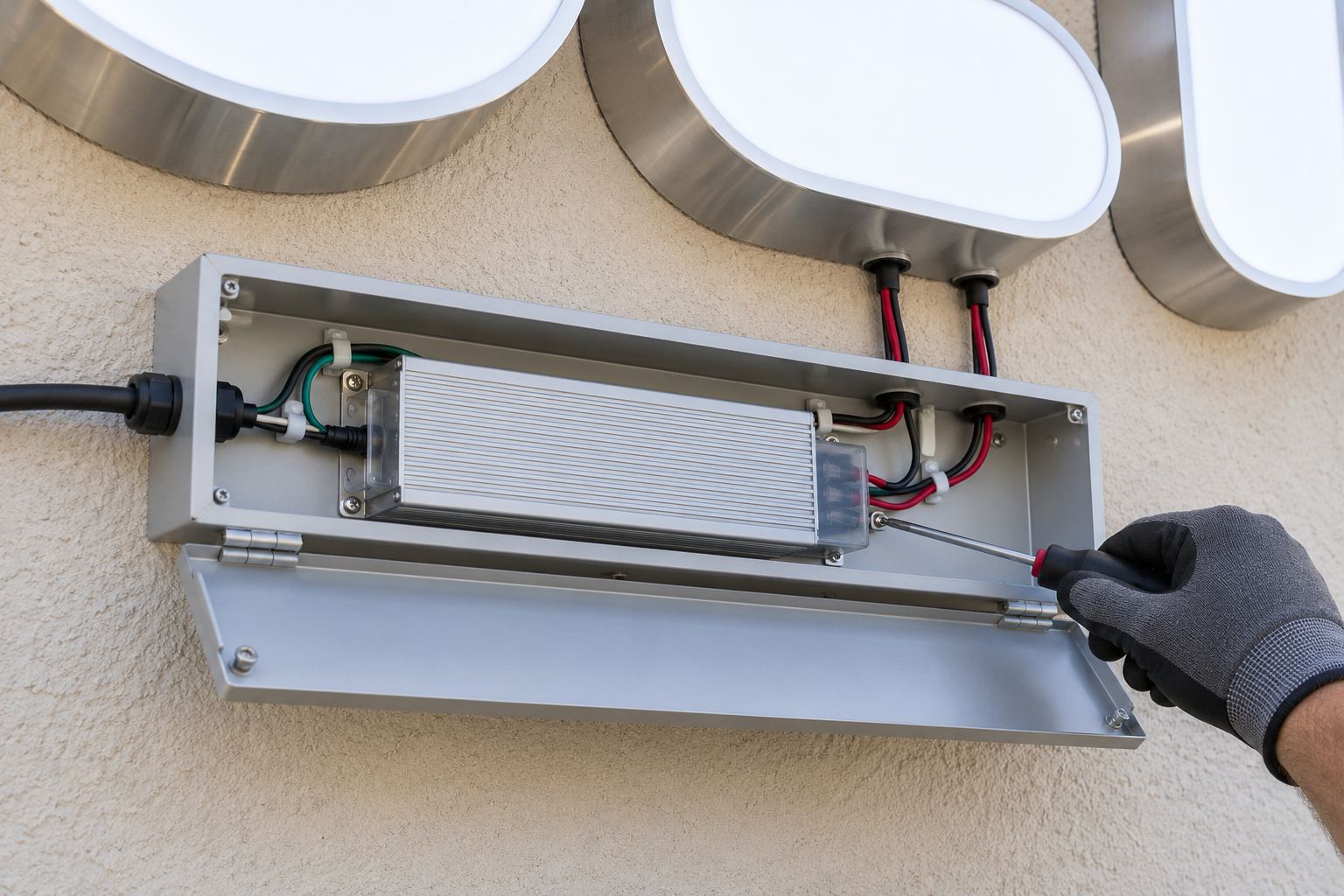
Our channel letters run on 12 V DC LED modules, and the power supply turns the building’s AC power into a steady 12 V. Size it by adding up the LED watts and choosing supplies that run at no more than about 80 percent of their rating, which leaves 20 percent headroom. Indoor signs usually plug in through an adapter; outdoor signs use hard-wired outdoor power supplies that a licensed electrician connects.
Every sign we build uses a UL-listed power supply and LED modules.
What a sign power supply does
LED modules cannot run straight off a wall outlet. The power supply (also called a driver or transformer) takes AC power in and puts low-voltage DC out. Supplies for 12 V sign modules are constant-voltage types: they hold the output at 12 V and let the current rise and fall with the load.
Two things must match:
- Voltage. A 12 V module needs a 12 V supply. A 24 V supply will overdrive it, and a constant-current driver made for other LED fixtures is the wrong type.
- Location. Plug-in adapters are made for dry indoor rooms. Outdoor supplies are built and rated for damp or wet locations.
Sizing: add up the watts, then add headroom
- Find the LED load. The number of modules times the watts per module gives the total. For a sign from us, ask for the total wattage of your drawing.
- Divide the load by 0.8. That is the smallest supply that keeps the load at 80 percent.
- Pick a supply at or above that number, or split the letters across two or more supplies.
| LED load | Smallest supply at 80 percent load |
|---|---|
| 24 W | 30 W |
| 40 W | 50 W |
| 48 W | 60 W |
| 80 W | 100 W |
| 120 W | 150 W |
| 200 W | 250 W, or split across several supplies |
Why the headroom: a supply running near 100 percent runs hot, and heat shortens its life. Sized to work at about 80 percent, it runs cooler and has margin to spare. A supply that is too small for its load can make the LEDs dim or flicker.
Some sign makers multiply the load by 1.2 instead of dividing by 0.8. Dividing gives a little more margin, about 25 percent, which does no harm.
What the sign costs to run
The same numbers tell you how much electricity the sign uses:
- Take the watts the supply draws. It is a little more than the LED load, because no power supply is perfectly efficient; the supply’s spec sheet lists its efficiency.
- Multiply by the hours the sign is on each day, then divide by 1,000. That gives kilowatt-hours (kWh) per day.
- Multiply by 365, then by the rate per kWh on your electric bill.
| Power drawn | Hours on per day | kWh per day | kWh per year |
|---|---|---|---|
| 50 W | 8 | 0.4 | about 146 |
| 100 W | 12 | 1.2 | about 438 |
| 150 W | 12 | 1.8 | about 657 |
A sign timer or a dusk-to-dawn photocell that cuts the hours cuts the total by the same share, and a dimmer lowers the watts while the sign is on. LED vs neon signs compares LED power use with glass neon.
Class 2 supplies, and why big signs use several
Many sign power supplies are Class 2. Their output is power-limited under the US electrical code and the UL standard for these supplies, which lowers the risk of shock and fire on the low-voltage side. At 12 V, a Class 2 output tops out at 60 W (5 A).
That is why larger signs often use several supplies, each feeding a group of letters, or one supply with several separately limited outputs. It helps when something fails, too: one bad supply darkens a few letters, not the whole sign. Supplies that are not Class 2 exist in larger sizes, but the wiring rules for their output are stricter, and your electrician will know what your city allows.
Never connect the outputs of two supplies together to get more power. Each supply feeds its own group of letters.
Plug-in adapters vs hard-wired outdoor supplies
| Plug-in adapter | Hard-wired outdoor supply | |
|---|---|---|
| Where | Indoors, dry locations | Outdoors, or anywhere damp |
| Input | 100–240 V AC from a wall outlet | Wired to the sign circuit |
| Who connects it | You plug it in | A licensed electrician |
| Typical signs | Reception logos, salon walls, desk letters | Storefronts, building letters, outdoor house numbers |
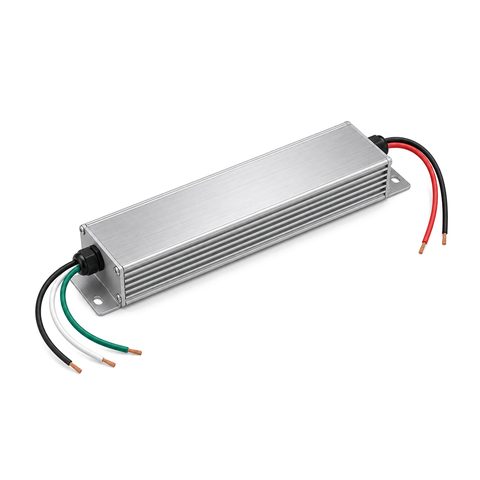
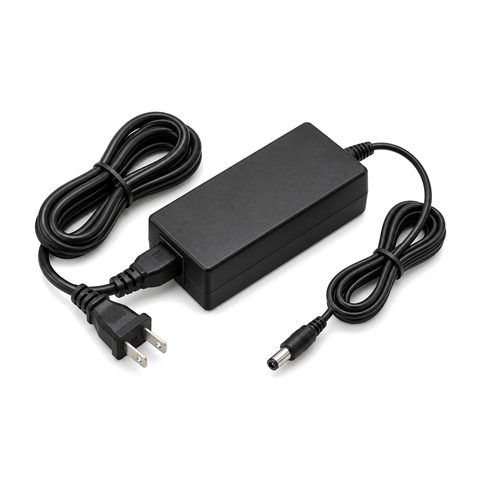
| Our part | Plug-in sign power adapter | Outdoor LED sign power supply |
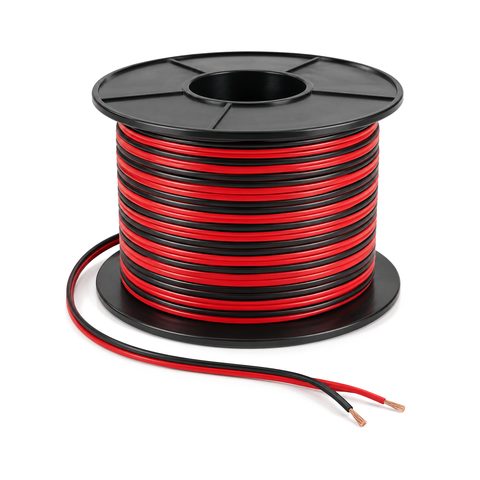
Indoors, keep the adapter where you can reach it and run only low-voltage wire behind or through the wall. The electrical code does not allow a plug-in cord to run inside a wall or through a hole in it. If the outlet is far from the sign, run low-voltage wire marked for in-wall use (CL2 or CL3) or have an outlet added behind the sign.
Outdoors, the supply is wired to a sign circuit with a disconnect switch. Sign electrical requirements covers the circuit, the switch and what to ask your electrician.
Where to put the power supply
Common places:
- Inside a raceway. A channel letter raceway holds the supplies and wiring right behind the letters, with fewer holes in the wall. See raceway vs direct mount.
- Behind the wall. Inside the building, above a ceiling or in a back room, with wires running through the wall to each letter.
- In a weatherproof enclosure on the wall or roof near the letters.
Wherever it goes, three rules apply:
- Keep it accessible. The code requires sign power supplies to be accessible and fastened in place. Do not seal one behind finished drywall with no way to reach it.
- Keep the 12 V runs short. At 12 V the current is high for the power delivered, so long, thin wires lose voltage and the farthest letters get dimmer. Sign power supply instructions we checked allow roughly 9 to 12 ft of 18 AWG wire to the first module at about 5 percent loss, with heavier wire for longer runs. Putting the supply near the middle of the sign, or using more than one, keeps every run short. For extension runs, see our low-voltage LED wire.
- Keep it cool and dry. Heat shortens a supply’s life, so avoid hot roof decks and full sun where you can, and use an outdoor-rated supply anywhere it can get wet.
Signs a power supply is struggling
- The whole sign, or one group of letters, goes dim or flickers.
- Letters switch off and back on by themselves.
- The supply runs very hot or buzzes.
- One group of letters is dark while the rest are fine, which often points to one supply out of several.
Channel letters not lighting walks through the checks, and how long LED channel letters last covers the life of each part.
Replacing a power supply on an existing sign
Match four things from the old supply’s label: the output voltage (12 V on our signs), a watt rating with 20 percent headroom over the load, an indoor or outdoor rating, and Class 2 if the sign was wired as Class 2. Send a photo of the label and the letters through repair an existing sign and we will suggest a match, or browse all power supplies.
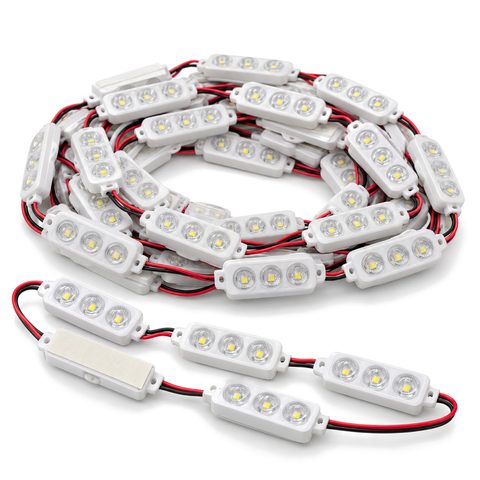 12V LED Modules for Channel Letters
 Front-Lit Channel Letters
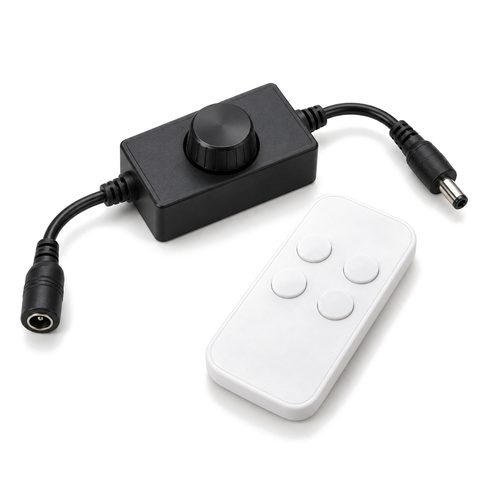 12V LED Sign Dimmer with Wireless Remote