Sign styles
Front-lit vs halo-lit vs open-face channel letters
The three ways channel letters light up, how each looks by day and at night, how far it reads, what wall it needs and where each style fits best.
Updated

Front-lit letters glow through a translucent acrylic face and read from the farthest away, which is why they are the usual choice for a storefront on a busy road. Halo-lit letters have a solid metal face and send their light onto the wall behind them: metal letters by day, a soft outline of light at night. Open-face letters show a line of LED neon inside an open steel channel, for a retro neon-sign look.
All three share the same base. Every letter we make has 304 stainless steel returns, LEDs inside and 12 V DC power. What changes is where the light comes out.
The three styles at a glance
| Front-lit | Halo-lit | Open-face with LED neon | |
|---|---|---|---|
| Where the light comes out | Through the acrylic face | Out the back, onto the wall | From a neon line inside the open channel |
| Look by day | Colored face, stainless sides | Solid metal letters: brushed, painted, gold or printed | Steel channel with the tube visible inside |
| Look at night | Evenly lit letters | Dark letters with a glowing outline | A line of light down each stroke |
| Reads best | From far away and at an angle | Close to medium distance, fairly straight on | Close to medium distance |
| Wall behind | Any | Light, matte, fairly smooth | Any |
| Typical places | Strip centers, restaurants, gyms, roadside signs | Lobbies, salons, clinics, offices, boutiques | Bars, cafes, barbershops, retro brands |
| Getting inside for service | On trim cap letters, the face comes off the front | The letter usually comes off the wall | Open at the front; the LED neon sits in clips |
Front-lit (face-lit) letters
A front-lit letter is a stainless steel can with LED modules inside and a translucent acrylic face on the front. The face is what glows. You pick its color, and that color shows in daylight too, so the sign works around the clock.
Choose front-lit when the sign has to work hard: a strip center, a road with traffic moving past, a facade people see from a sharp angle. The whole face sends light toward the viewer, so it reads from farther away than a halo, and it does not depend on the wall behind it. To size the letters for your distance, see how tall should sign letters be or use the letter height calculator.
Front-lit letters come with two edge styles: a trim cap that frames the face, or a trimless face with no visible border. Trim cap vs trimless compares them. If you want color effects, RGB color-changing letters are a front-lit build as well.
See front-lit channel letters and the front-lit letters collection.
Halo-lit (back-lit) letters
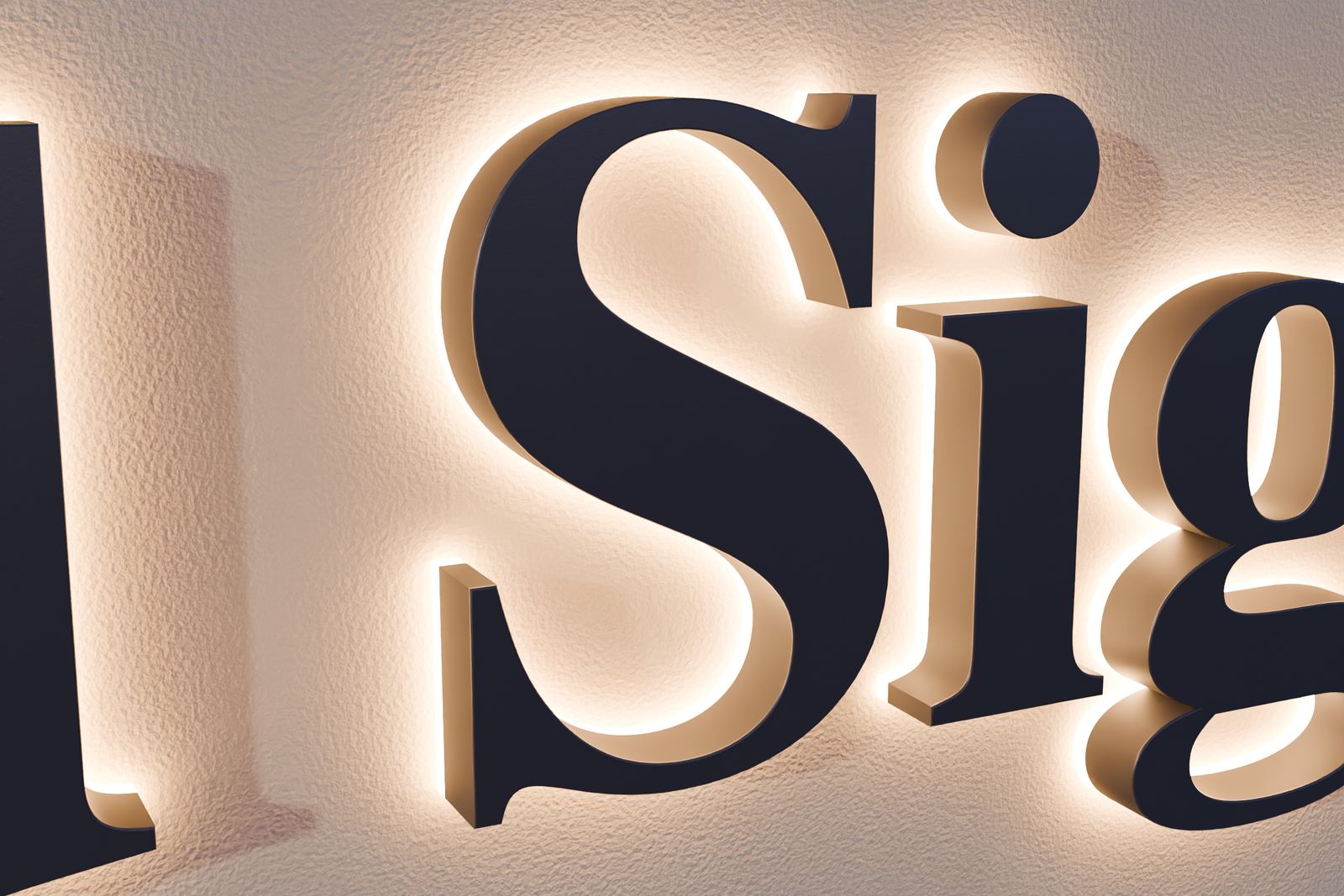
A halo-lit letter is closed at the front. The face is solid 304 stainless steel: brushed, painted any color, gold, or printed with your artwork. The back is translucent acrylic. The LEDs inside light that back, and the glow spreads onto the wall around each letter.
By day you see crisp, dimensional metal letters. At night the letters stay dark and a ring of light outlines them. It is a quieter look, which is why halo letters show up so often in lobbies, salons, clinics, law offices and upscale shops.
Two things to know before you choose it:
- The wall is part of the sign. The halo is light reflected off the wall. A light, matte wall gives a clean glow. A dark wall absorbs it, a glossy wall mirrors the LEDs as hot spots, a strongly colored wall tints the light, and rough stone breaks it into a patchy outline.
- It does not read as far as front-lit. Halo letters read well from the sidewalk or across a parking lot. From a sharp angle or far down the road the outline gets thin. If the sign must read from a highway, choose front-lit or front-and-back lit letters, which light the face and throw a halo.
How ours mount. Many sign shops hang halo letters on standoffs, usually 1.5 to 2 in off the wall, to give the light room to spread. Ours mount flush. Because the whole back of the letter is translucent acrylic, the light still spreads out around the edge of each letter while it sits on the wall. The result is a tighter halo close to the letter. If you prefer the wider, floating look, ask for standoffs and we add them. Halo-lit letters explained goes into walls, finishes and light colors.
See halo-lit channel letters and the halo-lit letters collection.
Open-face letters with LED neon
An open-face letter is a stainless steel channel with no face. A run of LED neon follows the centerline of each stroke, held in place by clips and usually set toward the front of the channel. You see a line of light framed by the steel edges.
Open-face letters began as housings for exposed glass neon. LED neon gives the same look with a flexible tube that runs on 12 V DC, so there is no glass to break and no high-voltage transformer. The style suits brands that want a retro or nightlife feel: bars, diners, barbershops, coffee shops, music venues.
The trade-off is upkeep. The channel is open, so dust, leaves and cobwebs collect inside, and outdoors the rain gets in. Plan on cleaning it now and then. The font matters too, because every stroke has to be wide enough for the tube and its clips. Open-face neon channel letters covers fonts, care, and indoor and outdoor builds.
See open-face neon channel letters and the open-face letters collection.
Front-and-back lit: both at once
A fourth option sits between the first two. Front-and-back lit letters have an acrylic face and a translucent acrylic back, so the face glows like a front-lit letter and a halo spreads on the wall behind it. They read from a distance like front-lit letters and add the depth of a halo, which makes them the most eye-catching of the lit styles at night. The wall still matters for the halo part, so the same light, matte surface helps. For every type in one place, including RGB, non-lit and marquee letters, see types of channel letters.
How to choose
- Start with the viewing distance. If people read the sign from a car or across a wide lot, front-lit is the safe pick. If they read it from the sidewalk or inside a lobby, any of the three works.
- Look at the wall. Halo needs a light, matte surface. On dark brick, glossy tile or busy stone, go with front-lit or open-face, or put halo letters on a backer panel.
- Decide whether day or night matters more. Front-lit shows your color by day and by night. Halo is about the metal by day and the glow at night. Open-face is about the neon line.
- Check your lease and your city. Many shopping center sign programs list the lit styles they allow. Cities set limits on sign size and sometimes on brightness, and some historic districts allow halo-lit letters where lit faces are not allowed. Check both before you order; sign permits explains what to look for.
- Ask for a drawing. Send your logo and wall size through the quote form. We email a free drawing with a lit preview and an exact price, and nothing is built until you approve it. For a rough number first, try the price estimator.
Mixing styles
One sign can use more than one style. A front-lit name next to a halo-lit logo is a common pairing, and front-and-back lit letters put both effects in one letter: an acrylic face that glows plus an acrylic back that throws a halo. For metal letters that are not lit at all, read 304 stainless vs aluminum and stainless steel letter finishes.

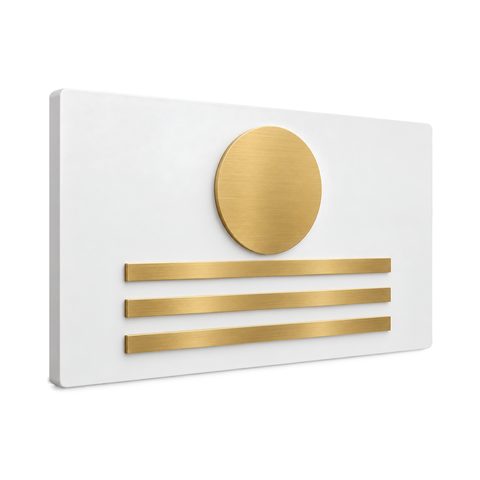 Channel Letters on a Backer Panel
 Stainless Steel Sign Standoffs
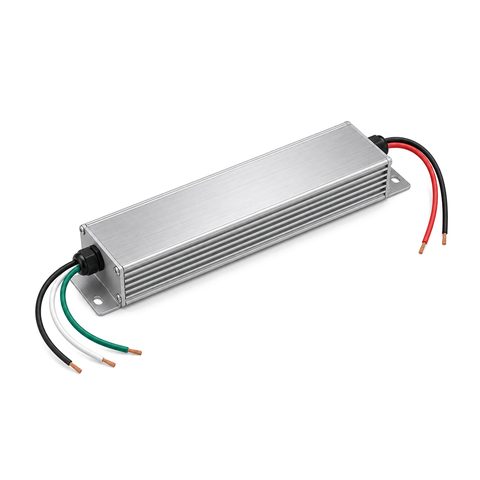 12V LED Sign Power Supply
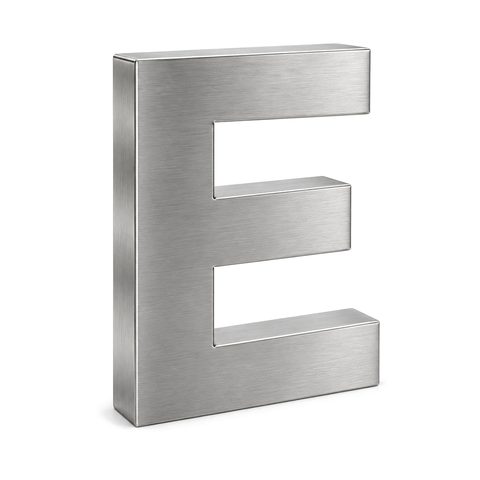 Brushed Stainless Steel Letters